Friday, June 8, 2012

Nalilembe inkalata yanini


I wrote a small letter

Since I wrote this, thought I'd just post it. It's from The Simon Poultney Foundation newsletter, introducing me to the foundation's supporters. 

Hi Friends of SPF! 

I’d like to introduce myself as the newest member of the SPF Zambia team. I have been in Zambia since February 2010 serving as a Peace Corps Volunteer, and I’ll be here with SPF through May 2013. For Canadians (or fellow Americans) not familiar with Peace Corps, it is a program of the US government. Here’s the blurb tagged on the end of Peace Corps press releases:

 About the Peace Corps: Since President John F. Kennedy established the Peace Corps by executive order on March 1, 1961, more than 200,000 Americans have served in 139 host countries. Today, 9,095 volunteers are working with local communities in 75 host countries. Peace Corps volunteers must be U.S. citizens and at least 18 years of age. Peace Corps service is a 27-month commitment and the agency’s mission is to promote world peace and friendship and a better understanding between Americans and people of other countries. Visit www.peacecorps.gov for more information.

50 years after its creation, the Peace Corps mission and 3 goals remain the same:
1. Help the people of interested countries in meeting their needs for trained men and women
2. Help promote a better understanding of Americans on the part of the peoples served
3. Help promote a better understanding of other peoples on the part of Americans
Peace Corps is not directly connected with university studies. I completed a B.S. in Plant Science, with emphasis in plant biology, in 2007 at the University of Missouri.

I finished my 27 months of Peace Corps service in April and am extending for a 3rd year, still as a Peace Corps Volunteer, but now working with the Simon Poultney Foundation.  For 2 years I lived in a rural village 20km from a paved road in a mud brick house with a grass thatched roof, without electricity or running water. My Peace Corps program is called LIFE—Linking Income, Food and the Environment. Some projects I worked on in my village were: fruit tree planting at the local school, organizing a field day to promote growing soybeans, linking rural subsistence farmers with soy seed and inputs, agroforestry with conservation farming, beekeeping with women’s groups, and leading a girls club to teach about HIV/AIDS and life skills.

I’ll be using my knowledge and experience working on agriculture and forestry projects in a rural Zambian community to help SPF and Chibwelelo Ward carry out their vision in those areas. We plan to help local beekeepers increase their production and income by equipping them with modern “top bar” hives to replace traditional tree bark hives, providing training where needed, and linking producers to reliable markets for their honey. We hope to organize an agricultural input loan program with conservation farmers so that they are able to plant their crops at the proper time to take full advantage the growing season and diversify the types of crops grown. We’ll be planting lots of trees: indigenous trees, trees for timber, and improved varieties of fruit trees whose yummy produce will be enjoyed by all, and can be sold to a company in Kabwe.

I’ll keep you posted on our progress! Please feel free to contact me.

Takuli ifipusho fimbi?

There are no more questions?


After 2 years and 3 months in Zambia, my favorite question I've been asked is still this one from May or June 2010:

From my host father and his friend Mr. Pauda,
"So this Bin Laden, he is American?"

Um, no.  


Monday, May 28, 2012

Ndeshako

Ndeshako means I am trying, in the habitual tense. So I may not always succeed, but I am still trying, throughout. All I can do is try and keep trying. However, if I'm honest, it's often more of a reminder to keep trying than an accurate description of my life.

(I even guessed right with the spelling. Confirmed it today with a teacher at the local school. Dumb maybe, but I wanted to make sure I had it right before I explained, in case I had to change it.)

Tuesday, May 22, 2012

Bushe mulefwaya ukwishiba finshi?

Whatchya'll wanna know?


I'll still try to get better at blogging all by myself, but it's a lot easier if I have a question to answer. So if you want to know something about Zambia, me, what I did or do, then comment it up and ask away!


Saturday, May 5, 2012

Naliipika mu insaka

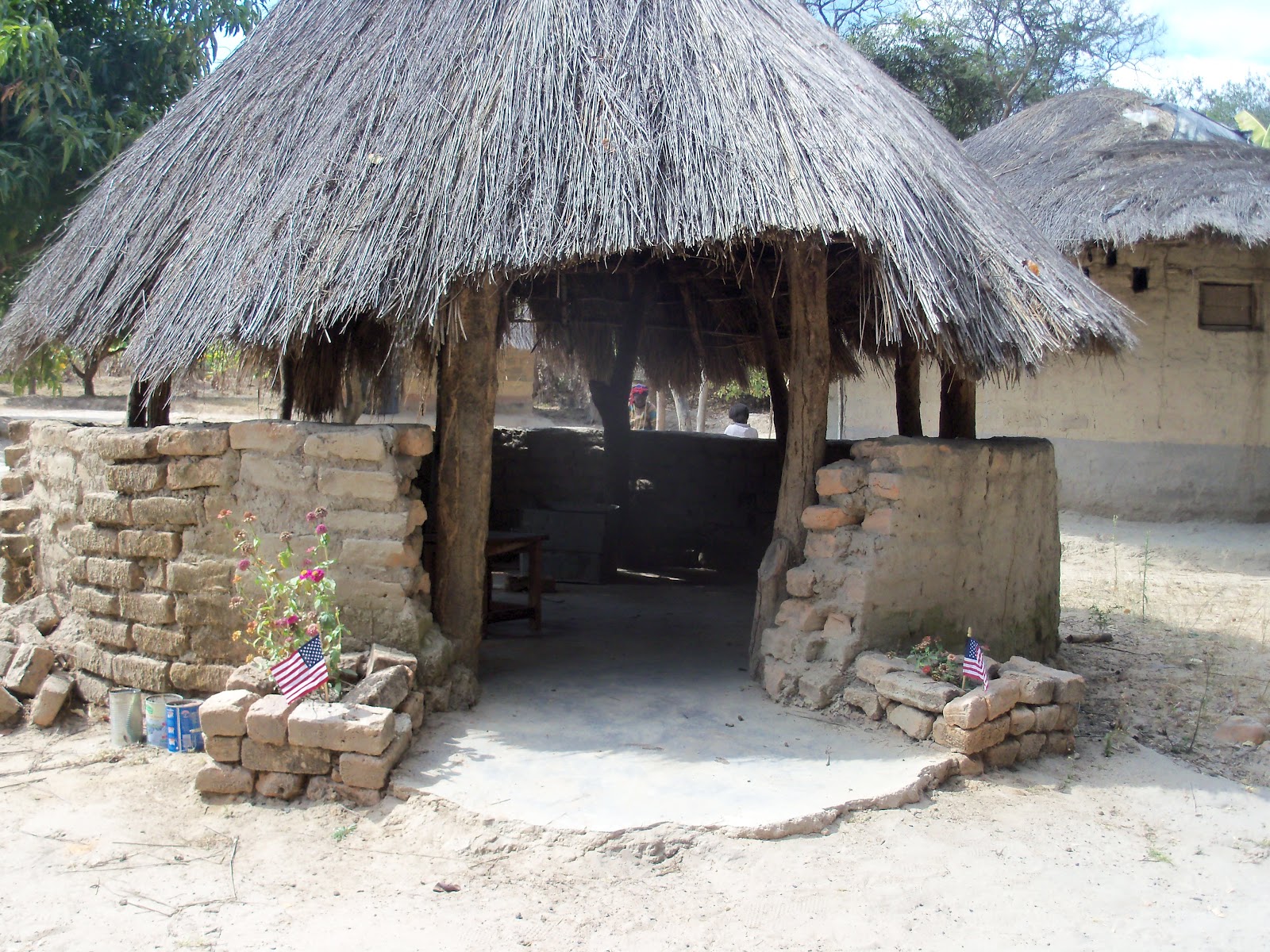
I cooked in an insaka

Funny how I'm finally showing where I lived, now that I'm not there anymore. Guess that's cause I have internet now. Better late than never I suppose.

This is my insaka (cooking shelter), decked out for 4th of July.
in relation to my hut. that's my dish drying rack with laundry tubs and my solar shower on it.

I cooked on a brazier with charcoal.

seen here with corn cob charcoal
seen here empty with a pretty butterfly
So, I didn't actually use my insaka very much. Turns out it was the stage for the musungu show. (musungu is white person if you hadn't got that yet)

I cooked there most of the time, mostly to justify its existence. Eventually I stopped caring and just cooked on my little porch. But I always ate in my house. Though the weather was usually nice out, it was much more pleasant to eat inside, in peace. Eating inside, I still always got a nice breeze, just not the scenery. Inside, I could listen to my radio (at lunch) (I heart BBC and VOA) or watch The Office on my ipod (dinner).  Maybe I would've interacted with my family more if I spent more time in my insaka instead of inside my house, but I much preferred inside, alone, in peace.

Outside I would be constantly asked about everything I was cooking with or eating. Or asked about my radio or asked to give them my magazine, newspaper or book. My ipod stayed secret for the entire 2 years. Maybe the constant watching of all my actions and bombardment of questions and requests for my stuff might have died down by the end of 2 years if I stuck it out sitting in my insaka. I didn't have the patience for that. (and I don't think it would've because new kids kept coming to stay with us. Seemed like there were always new little eyes trained on the musungu.) Turns out I like my privacy.
The most important reason for me to have an insaka was that it became my "office". Whenever someone would come to see me, we could sit there and discuss whatever. I wasn't so comfortable with people in my hut. Too many musungu things to explain, and if the visitor was a man, the public insaka was obviously much better than inside.

Wednesday, May 2, 2012

Mukati mu nganda yandi


Inside my house
My "sitting room". (That was my guest bed/couch. The mosquito net was only up in my sitting room when I had visitors.)
 
My kitchen/pantry (didn't cook in there)


Panorama

Sorry I don't have a picture of my bedroom. It's in the middle there.


Christmas decorations :)

Thursday, April 26, 2012

Ndeshala mu Zambia, 1 year futi

I am staying in Zambia, another year

Boy, my blog is terrible.
I may have said that before, though not in so many words.

I'm not going to pretend that I'm really going to make it better, but I am at least going to resume attempting to actually post on it.

Because, now, I have internet!

Briefly (ish): I finished my 2 years of Peace Corps service and have extended for a 3rd year. I moved out of my village
bye bye hut! Shalenipo.
 and am now just about settled in to my swanky new digs at Kakulu Farm. I have internet, running water,  a hot shower (most of the time), and (sort of) electricity. And no more biking 20km to the road with my big backpack of stuff to go anywhere. I'll be here for a year, til May 2013.
I'm still a Peace Corps Volunteer but instead of working on my own, I now work with The Simon Poultney Foundation. It's gonna be EPIC. wink.

Sigh...I still really don't like blogging.

There's an awful lot of interesting things that have happened to or around me in the last 2 years. Haven't shared a one of 'em. I'll see what I can do.

Or maybe I'll just give occasional, boring "this is what I'm doing" updates. At least pictures will upload now. That should help.